Discover interesting facts about Scotland — from ancient castles and Highland landscapes to unique traditions, history and culture. Learn what makes Scotland one of the most fascinating countries in the world.
Scotland is one of the most fascinating and beautiful countries in the world, known for its dramatic landscapes, historic castles, rich culture and ancient traditions. From the rugged Highlands and mysterious lochs to vibrant cities like Edinburgh and Glasgow, Scotland offers a unique blend of history, nature and legend.
This page explores a collection of interesting facts about Scotland, including its history, famous landmarks, cultural traditions and remarkable natural landscapes. You will discover surprising details about Scottish inventions, historic battles, legendary creatures like the Loch Ness Monster, and the people who shaped Scotland’s identity.
Scotland Has Over 790 Islands
Scotland has more than 790 islands, but only about 90 are inhabited.
The National Animal Is a Unicorn
The unicorn has been Scotland’s national animal for centuries and symbolises purity and power.
Scotland Has More Than 2,000 Castles
Across Scotland there are over 2,000 castles, from ancient ruins to grand royal residences.
The Loch Ness Monster Legend Dates Back to 565 AD
The earliest recorded sighting of Nessie was written about by St Columba in the 6th century.
Edinburgh Was the First City With a Municipal Fire Brigade
In 1824, Edinburgh created the world’s first city fire brigade.
Scotland Has One of Europe’s Oldest Trees
The Fortingall Yew in Perthshire is estimated to be 3,000–5,000 years old.
The Telephone Was Invented by a Scot
Alexander Graham Bell, born in Edinburgh, invented the telephone in 1876.
Golf Originated in Scotland
The modern game of golf began in Scotland in the 15th century, and St Andrews is known as the Home of Golf.
Scotland Has the Shortest Scheduled Flight in the World
The flight between Westray and Papa Westray in Orkney takes around 90 seconds.
Scotland Has Its Own Legal System
Scotland has a separate legal system from England, with its own courts and laws.
The Deepest Loch in Scotland Is Loch Morar
Loch Morar is over 300 metres deep, making it the deepest freshwater loch in Scotland.
Scotland Has Three Official Languages
Scotland recognises English, Scots and Scottish Gaelic.
Scotland Has the Highest Percentage of Redheads
About 13% of Scots have natural red hair, the highest percentage in the world.
The World’s First Colour Photograph Was Taken by a Scot
Physicist James Clerk Maxwell demonstrated the first colour photograph in 1861.
The Kelpies Are the Largest Horse Sculptures in the World
The famous Kelpies near Falkirk stand 30 metres tall.
Scotland Has Over 30,000 Lochs
There are more than 30,000 freshwater lochs across the country.
The Scottish Highlands Are One of Europe’s Last Wildernesses
Large areas of the Highlands remain wild and sparsely populated.
The Scottish Flag Is One of the Oldest National Flags
The Saltire dates back to the 9th century.
Scotland Has More Than 6,000 Miles of Coastline
The country’s coastline stretches for around 10,000 kilometres.
The Oldest University in Scotland Was Founded in 1413
The University of St Andrews is Scotland’s oldest university.
Edinburgh Castle Sits on an Extinct Volcano
The castle stands on Castle Rock, the remains of an ancient volcano.
The Royal Mile Is About One Scots Mile Long
A Scots mile is slightly longer than an English mile.
Scotland Is Home to the UK’s Highest Mountain
Ben Nevis stands at 1,345 metres.
The Jacobite Steam Train Is One of the World’s Most Famous Trains
It crosses the Glenfinnan Viaduct, featured in the Harry Potter films.
Scotland Invented Many Everyday Things
Scottish inventions include the telephone, television, penicillin and the steam engine improvements.
The World’s First International Football Match Was Played in Scotland
Scotland played England in 1872 in Glasgow.
Scotland Has Its Own Parliament
The Scottish Parliament was re-established in 1999 in Edinburgh.
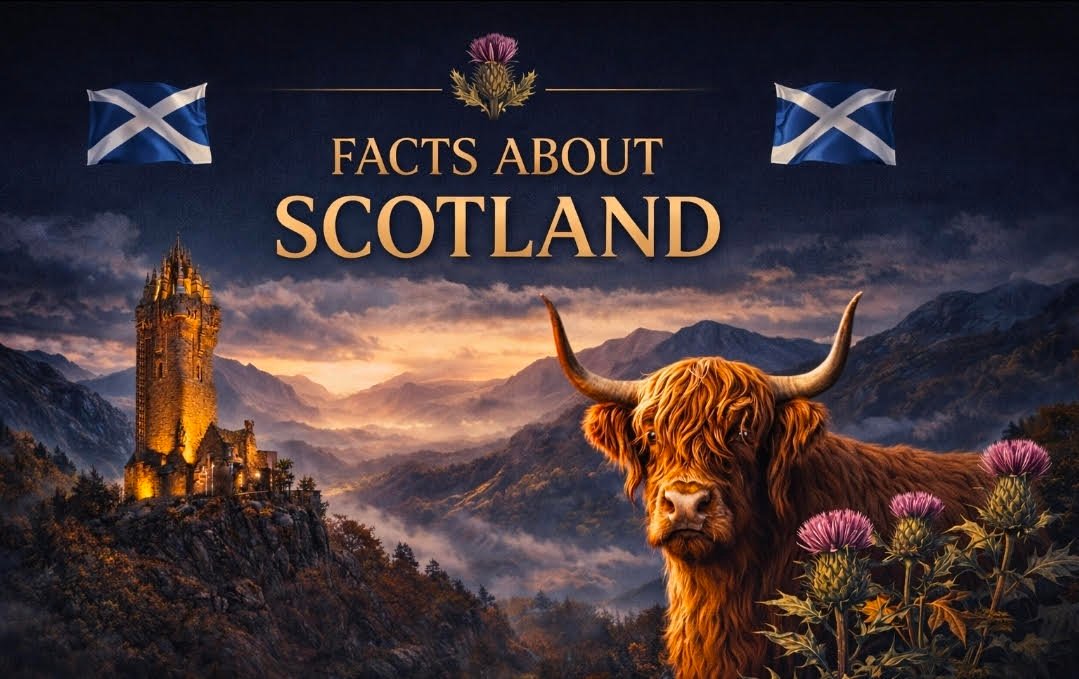
The Highland Cow Is One of Scotland’s Most Recognisable Animals
These hardy cattle are perfectly adapted to harsh Highland weather.
Bagpipes Are Strongly Associated With Scotland
The Great Highland Bagpipe became a symbol of Scottish culture and military tradition.
The World’s First International Football Match Was Played in Scotland
Scotland played England in 1872 in Glasgow.
Scotland’s Weather Can Change Very Quickly
Locals often say you can experience four seasons in one day in Scotland.
Scotland Has Over 900 Offshore Islands
Including very small ones, Scotland actually has over 900 islands around its coastline.
Scotland Is Home to the World’s Oldest Tree-Lined Avenue
The famous Beech Avenue at Drumlanrig Castle is one of the oldest tree-lined avenues in Europe.
Scotland Has Its Own National Poet
Robert Burns is Scotland’s national poet, celebrated every year on Burns Night (25 January).
Scotland Is the Birthplace of Whisky
Scotland produces some of the finest whisky in the world, with over 130 active distilleries.
The World’s First International Rugby Match Was Played in Scotland
The first official international rugby match was played in Edinburgh in 1871 between Scotland and England.
Scotland Has Some of Europe’s Darkest Skies
Several areas in Scotland are designated Dark Sky Parks, perfect for stargazing.
Scotland’s National Dish Is Haggis
Haggis is traditionally made from sheep’s offal, oats and spices and is often served with neeps and tatties.
Scotland Has Over 150 Distilleries
The country is famous for Scotch whisky, produced mainly in regions such as Speyside, Islay and the Highlands.
Scotland Is One of the Windiest Countries in Europe
Its location in the North Atlantic means Scotland often experiences strong winds and dramatic weather.
Scotland’s Motto Is “Nemo Me Impune Lacessit”
The national motto means “No one provokes me with impunity.”
Scotland Has Over 280 Munros
A Munro is a Scottish mountain over 3,000 feet (914 m) high. There are 282 Munros in Scotland.
Scotland Has the Oldest International Football Rivalry
The famous Scotland vs England football rivalry dates back to 1872.
Scotland Has More Freshwater Than England and Wales Combined
Due to its thousands of lochs and rivers, Scotland holds most of the UK’s freshwater resources.
Scotland Was Once Covered by Massive Glaciers
Many of Scotland’s landscapes, including glens and lochs, were shaped by glaciers during the Ice Age.
Edinburgh Has More Listed Buildings Than Any Other UK City
Edinburgh has over 4,500 listed buildings, many dating back centuries.
Scotland Has the UK’s Largest National Park
Cairngorms National Park is the largest national park in the United Kingdom.
The Scottish Crown Jewels Are Among the Oldest in Europe
The Honours of Scotland date back to the 15th century.
47 Interesting Facts About Scotland | 47 Interesting Facts About Scotland | 47 Interesting Facts About Scotland | 47 Interesting Facts About Scotland | 47 Interesting Facts About Scotland | 47 Interesting Facts About Scotland | 47 Interesting Facts About Scotland | 47 Interesting Facts About Scotland | 47 Interesting Facts About Scotland | 47 Interesting Facts About Scotland | 47 Interesting Facts About Scotland | 47 Interesting Facts About Scotland |

Follow us on Facebook